

Attackers no longer break in. They log in.
Identity is the new perimeter. Adversaries exploit trusted credentials, excess privileges, and misconfigured access to move freely across digital and physical systems. The gap between detection and governed remediation is where exposure compounds – and where most organisations remain structurally reactive.
The Challenge
Despite decades of security investment, most organisations remain reactive. The root causes are structural, not technical.
Cloud
IaaS, PaaS, SaaS, and serverless assets – ephemeral by nature, difficult to track, easy to misconfigure.
External
Internet-reachable assets in public IP space – the most commonly probed surface and the most visible to attackers.
Internal
On-premises IT, OT, and IoT assets – legacy systems often unpatchable and highly interconnected.
End User & Digital
Hybrid workforce endpoints and SaaS accounts that sit outside traditional perimeter controls.
Autonomous IT Engine
Why Traditional Vulnerability Management Is No Longer Sufficient
Patch-Only Thinking
VM generates remediation lists but cannot address unpatchable exposures, identity misconfigurations, excess privileges, legacy OT protocols, or misconfigured SaaS permissions.
No Business Context
Prioritisation does not reflect asset criticality or the operational impact of an exposure on running processes and dependent applications.
No Mobilisation Path
Security teams identify issues but rarely control the fix – without cross-team workflows and a governed action layer, exposure persists long after detection.
Xautomata’s CTEM Approach
Continuous Threat Exposure Management – from exposure to governed action.
CTEM is not a tool – it is a programme. Xautomata provides the engine that operationalises each of its five phases within a single, unified platform.
1
Scoping
Define the assets, identities, and processes in scope. Establish criticality rankings and business context that will drive prioritisation. Align security risk to operational and business impact.
Discovery
Xautomata ingests IT, OT, cloud, and identity signals – EDR/XDR, ESM, IAM, vulnerability scanners – to build a continuously updated Digital Twin. Real-time visibility across all asset classes, with cross-domain context.
2
3
Prioritisation
The XAL Behavioral Model simulates attack paths and what-if scenarios – not just CVSS scores. Which exposures, if exploited, would cause the greatest business impact? Which are reachable from the current attacker position? Prioritisation reflects operational reality, not theoretical severity.
Validation
Validate that proposed remediations are safe to execute before acting. Simulate privilege revocations, patch deployments, and configuration changes. Confirm that fixing one exposure does not create another.
4
5
Mobilisation
Autonomous agents execute governed remediation within pre-approved boundaries. Compensating controls are applied immediately where patching is not possible. Human escalation is triggered – with full diagnostic context – for decisions that require cross-functional approval.
Deterministic Governance
White-box automation. Every action is explainable.
At the core of Xautomata is a white-box approach. Unlike opaque AI, our system’s logic is transparent and based on explicit Behavioral Models.
We validate the full context of every identity, asset relationship, and threat signal before acting – ensuring every remediation or compensating control is safe, compliant, and completely auditable.
This matters in regulated environments. When a regulator or auditor asks why an action was taken, you have a complete, structured answer – not a black-box inference.
Use Cases

Resilient IoT Patching
Manual IoT patching is not scalable. Fragmented device environments – cameras, alarms, ATMs, industrial sensors – require different patching mechanisms for each device class. Compliance pressure from NIS2 and DORA adds urgency. Xautomata acts as the Trust Orchestrator: it verifies device health before patching, applies the right method per device type, and integrates human approval for high-risk actions.
- Native (Push/Pull) – software agents and standard protocols for modern gateways and network switches
- Orchestrated (API) – manufacturer API and VMS interaction for professional cameras and video systems
- Embedded (Controlled) – patch packaging via configuration for legacy alarms, ATMs, and sensors
60–70%
Reduction in manual tasks related to IoT patch management

Short-Lived Certificate Lifecycle Management
Certificate renewal volume has increased 800% as lifespans have shortened. By 2029, industry standards will require renewal every few weeks rather than annually. Manual management at this frequency is a critical risk to business continuity. Xautomata’s multi-modal automation handles certificate renewal across device classes with integrity-linked identity verification.
- ACME, SCEP, and EST protocols for IT servers and modern networking (Cisco/Juniper)
- Orchestrated renewal for video conferencing systems and professional cameras
- Firmware/config packaging for legacy alarms, ATMs, and industrial sensors
- Full audit-ready traceability for DORA and NIS2 compliance

Resilient Identity Governance & Behavioral Response
Identities are not correlated with assets and their relationships in most organisations, leaving unpatchable exposures invisible. Xautomata correlates access logs, HR systems, and threat intelligence to identify anomalies and trigger calibrated, automated responses – without disrupting legitimate operations.
- Normal behaviour – passive monitoring, continuous alignment with IAM policies
- Suspicious activity – MFA reset and session kill, immediate risk removal with low operational impact
- Critical exposure – privilege isolation with mandatory SOC Manager approval before action

Attack Path Mapping & What-If Simulation
The questions that vulnerability management cannot answer: What happens if I revoke this privilege? Which attack paths lead to our critical assets? Which open doors can an attacker walk through today?
Xautomata’s Behavioral Model simulates these scenarios before acting, enabling security teams to validate changes without operational risk.
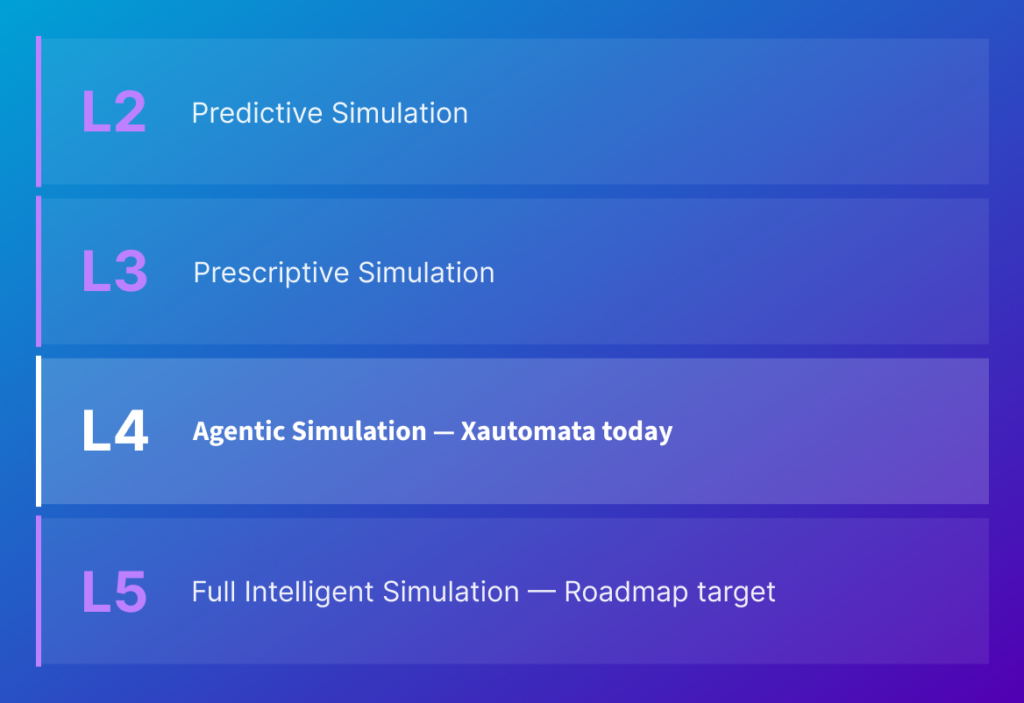
Gartner Intelligent Simulation Roadmap
Operating at Level 4 – Targeting Level 5.
Xautomata operates at Level 4 (Agentic Simulation) on the Gartner Intelligent Simulation Technical Functionality Roadmap – characterised by semi-autonomous decision making across identity, asset, and threat scenarios.
Our product roadmap targets Level 5: full intelligent simulation, enabling a fully autonomous security posture management programme.
Source: Gartner, 15 August 2025, ID G00813153 – Emerging Tech: AI Vendor Race: Conquer Complexity, Deliver Value and Drive Revenue Using Intelligent Simulations.
Key benefits
From reactive patching to continuous, governed exposure management.
Move from reactive patching and detection to continuous, governed exposure management
Reduce the time between exposure identification and remediation – without expanding security headcount
Demonstrate continuous compliance to NIS2 and DORA regulators through automated audit trails
Manage exposures that traditional VM cannot address: identity misconfigurations, legacy OT protocols, SaaS permissions
Maintain a security posture that scales with your infrastructure – not with your team size
Ready to close the trust gap in your IT Operations?
Talk to our team about your infrastructure, your challenges, and how Xautomata fits your environment. No generic demos – we work from your reality.